Project purpose
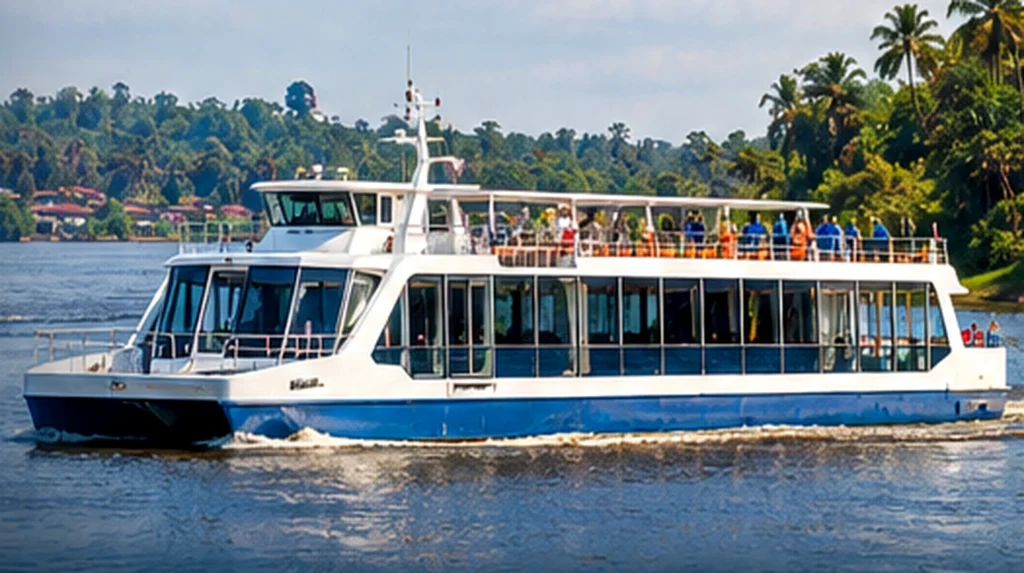
The project is aimed at organising production and deliveries of Russian shallow-draft river vessels with electric and hybrid propulsion for inland waterways in Russia and abroad. It addresses routes with shallow waters, seasonal level changes, limited landing infrastructure and a need for reliable transport links between settlements.
The concept is based on a versatile Russian vessel platform that can be adapted to route conditions, mission profile and customer requirements. Both complete vessels and large-unit assembly kits are considered.
Applications
- Regular passenger services.
- River and ferry crossings.
- Food and consumer-goods deliveries.
- Transport support for remote areas.
- Floating medical points.
- Floating shops.
- Tourist and cruise services, including VIP layouts.
- Other specialised configurations based on the common platform.
These applications describe possible adaptations and do not mean that every configuration is already in serial production.
Technical features
- Shallow draught.
- Paddle-wheel propulsion.
- Electric or hybrid powertrain.
- Low noise in electric mode.
- Maintainability and adaptation to route-specific requirements.
- Operation on routes with limited landing infrastructure.
- Potential for local assembly and after-sales support.
- Potential adaptation to low-carbon transport programmes.
An unmanned configuration may be considered in the future as an adaptation pathway, not as a current declared product feature.
Indicative passenger configurations
The table below summarises the passenger variants currently under consideration. The additional energy-storage, auxiliary-generator and fast-charging data apply to Option 3 only.
| Parameter | Option 1 | Option 2 | Option 3 |
|---|---|---|---|
| Length, m | 35.5 | 35.5 | 35.5 |
| Beam, m | 9.5 | 9.5 | 9.5 |
| Maximum draught, m | 0.734 | 0.734 | 0.734 |
| Speed, km/h | 12 | 12 | 12 |
| Operating time at maximum speed, h | 6 | 4.5 | 6 |
| Passenger capacity | 178 | 100 | 250 |
| Cabins | 19 | 2 | None |
| Galley | Included | Not specified | Not specified |
| VIP layout | Possible | Possible | Possible |
| Energy storage, kWh | Not specified | Not specified | 373 |
| Auxiliary diesel generator, kW | Not specified | Not specified | 120 |
| Fast-charging capability | Not specified | Not specified | Provided |
The listed figures describe indicative variants. Final configuration, technical characteristics and operating performance are defined against the customer’s technical specification.
Manufacturing capability and lead times
The project allows for serial production of vessel kits with scale-up depending on order volume. Preliminary production estimates indicate a range from 36 to 160 kits per year, depending on the production programme, configuration and supply-chain support.
Lead times depend on the number of vessels, configuration, outfitting scope and manufacturing schedule. Individual high-specification layouts require separate planning.
Delivery model and local assembly
Two principal implementation formats are considered.
Complete vessel delivery
Manufacture in Russia, customer-specific outfitting, testing and subsequent delivery.
Delivery of vessel kits
Production in Russia followed by transportation and large-unit assembly in the country of operation.
- Prepare and agree the technical assignment.
- Adapt the vessel design to the customer’s needs.
- Select equipment and components.
- Manufacture and complete the vessel or kit.
- Arrange transport packaging and logistics.
- Deliver to the assembly location.
- Carry out large-unit assembly, supervision and commissioning.
- Train personnel and crews.
- Provide follow-up technical support.
Transfer of selected local assembly and service processes to local companies on a contractual or licensing basis is being considered. This should not be presented as an already executed licence transfer or an existing overseas assembly network.
Energy and charging infrastructure
Electric and hybrid inland-waterway vessels require a supporting infrastructure concept.
- Energy storage systems. Selection of batteries, controls, protection and condition-monitoring systems.
- Charging stations. Shore-based charging complexes, including fast-charging capability where technically compatible.
- Autonomous power supply. Consideration of gas-engine sets and other local power-generation sources where grid capacity is limited.
- Gas infrastructure. Assessment of natural-gas and, where required, LNG-based solutions for shore facilities and local generation.
- Integrated infrastructure. Potential local energy hubs combining generation, storage, charging, distribution and service support.
These items represent cooperation workstreams rather than confirmed integrations into all vessel models.
Geography and target markets
Russia. Inland-waterway regions requiring regular transport with shallow-water constraints.
African countries. A priority export direction for markets interested in transport accessibility, local assembly and service infrastructure.
Other international markets. Additional countries with comparable inland-waterway conditions.
Industrial cooperation opportunities
- Shipbuilding and manufacturing cooperation.
- Marine electrical equipment.
- Battery systems.
- Charging infrastructure.
- Autonomous power solutions.
- International logistics.
- Local assembly and service.
- Customers and transport operators.
- Finance and export support.
Role of the Cluster
The Cluster VTOA acts as initiator, organiser and coordinator of the project. It helps structure industrial cooperation, identify partners, prepare integrated proposals, promote the project on industry and international platforms, and support financing discussions. The Cluster is not presented as the owner of the vessel technology or the vessel manufacturer.
Project stages
- Technical and product concept definition.
- Market assessment and customer search.
- Formation of industrial, energy and international cooperation.
- Preparation of techno-commercial offers and financing models.
- Organisation of pilot delivery, assembly and commissioning.
- Scaling up deliveries and service infrastructure.
Current stage: formation of industrial and international cooperation.
Partners and cooperation workstreams
See which capabilities are already covered and where new partners are welcome.
Shipbuilding and manufacturing cooperation
Vessel kits, hulls, structural elements and selection of manufacturing contractors.
Marine electrical equipment
Electric propulsion, controls, automation, navigation and other electrical components.
Battery systems
Energy storage, battery management systems, electrical protection and integration.
Charging infrastructure
Development, supply and integration of charging stations for electric river transport.
Autonomous power solutions
Gas-engine units, local generation and hybrid energy hubs for off-grid sites.
International logistics
Transport packaging, multimodal deliveries, shipment of vessel kits, insurance and trade support.
Local assembly and service
Supervised assembly, organisation of assembly capability, maintenance, repair and training.
Customers and transport operators
Identification of organisations interested in acquiring vessels and developing regular river transport.
Finance and export support
Financial instruments, export insurance and support for transport-infrastructure development.
Project cooperation details are disclosed only as agreed. Commercial terms and nonpublic materials are not displayed.
Project export potential
International applications may be assessed as the project develops. The Cluster can support market research, partner search and the adaptation of technology for overseas customers.
The Cluster supports demand assessment, partner search, cooperation, product adaptation and overseas market development for Russian technology.
International opportunities for members ↗Cluster coordination
The Cluster assesses industry demand, connects developers, manufacturers and customers, coordinates requirements and supports preparation for qualification or pilot deployment. Testing, production and commercial supply are performed by the competent parties.